

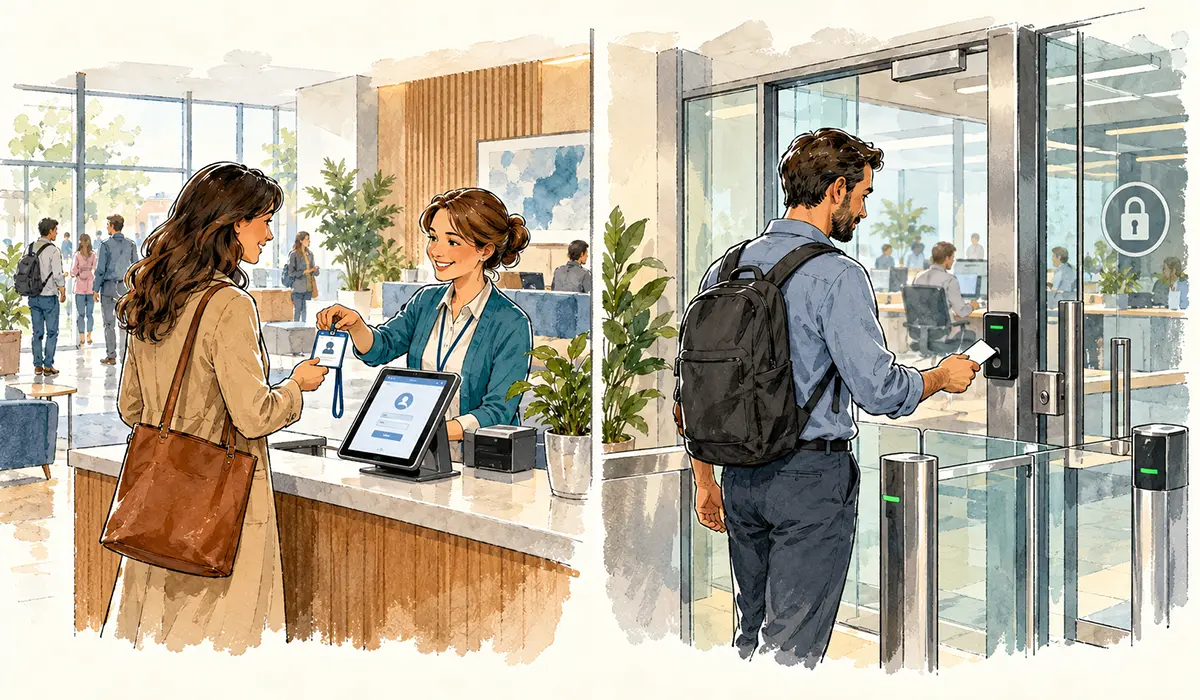
Visitor management and access control are often discussed together, but they solve different problems. One is mainly concerned with who is entering the workplace and why, while the other is concerned with whether that person is allowed through a particular door, gate or restricted area.
The two can work together, but they are not interchangeable.
Visitor Management Starts With Identity and Purpose
Visitor management focuses on the person arriving. The system may record details such as:
- Name
- Company
- Person being visited
- Reason for the visit
- Arrival time
- Departure time
- Visitor type
The aim is to create a clear record of who is onsite and why they are there. That information can support reception, security, reporting and emergency procedures.
Access Control Starts With Permission
Access control is different. Its job is to decide whether someone can physically enter a particular area.
That could mean:
- Unlocking a front door
- Opening a security gate
- Allowing access to a staff-only zone
- Restricting entry to a server room
- Controlling access to a warehouse or plant room
Access control systems usually rely on credentials such as key cards, mobile passes, PINs or other forms of authorised identity.
The question is not simply, “Who are you?” It is also, “Are you allowed through this point?”
The Two Systems Solve Different Problems
A visitor management system may know that a contractor has arrived for a maintenance job. An access control system may determine whether that contractor can enter the maintenance area.
That is the key distinction.
Visitor management provides context around the person, while access control enforces physical entry rules. One is about visibility. The other is about permission.
Why Businesses Often Need Both
A workplace can have strong access control and still have poor visitor visibility.
For example, a guest may be let through a secure door by an employee, but the organisation may have no central record of who they are, why they are there or when they leave.
The reverse can also happen. A workplace may record every visitor at reception but still rely on manual doors and staff supervision once the visitor moves deeper into the site.
Using both systems together can help close that gap.
A Visitor Badge Is Not the Same as Access Permission
A visitor badge may show that someone has completed the sign-in process. It does not necessarily mean they should be able to enter every area of the workplace.
In many environments, visitors may still need to remain with a host or stay within designated areas. Access control can add another layer by limiting movement to approved locations.
That becomes more important in workplaces with sensitive, hazardous or restricted spaces.
Where Integration Becomes Useful
The real value appears when visitor management and access control systems can work together.
Visitor management and access control serve different primary functions, but modern platforms such as Teamgo can integrate with access control systems to create a more connected entry and security process.
A visitor may check in, complete the required steps and then receive temporary access for the areas they need. When the visit ends, that access can be removed.
That can create a more controlled process than managing visitor records and door access separately. For larger organisations, it can also reduce manual administration.
Different Visitors May Need Different Access
Not everyone who signs in should receive the same permissions.
A client attending a meeting may only need access to reception and a meeting room. A contractor may need access to a maintenance area. A delivery driver may only need access to a loading zone. A consultant may be permitted into one office but not another.
Visitor management helps identify the person and the reason for the visit. Access control can then enforce the physical boundaries that apply to that visit.
Why This Matters for Security
Security problems often occur in the gap between knowing someone entered the building and knowing where they can go afterwards.
An accurate visitor record is useful, but it does not physically stop someone from entering a restricted area. A locked door is useful, but it does not explain who the person is or why they are onsite.
The two systems answer different security questions. Together, they can create a clearer picture of both presence and movement.
What Happens During an Emergency?
The distinction also matters during emergencies.
Visitor management can help show who was recorded onsite before an evacuation. Access control data may provide additional information about which areas were accessed.
That does not replace emergency procedures, but it can provide useful context when teams are trying to account for people or understand what happened.
Which One Does a Workplace Need?
For some small workplaces, visitor management alone may be enough. For others, particularly those with restricted areas, valuable assets, hazardous environments or sensitive information, access control may also be necessary.
A useful way to think about it is:
Visitor management asks: Who is here and why?
Access control asks: Where are they allowed to go?
The Best Approach Is Usually Connected
The distinction between visitor management and access control is becoming more important as workplaces become more complex.
Organisations are no longer just trying to record who walked through the front door. They are trying to understand who is onsite, why they are there and what they should be able to access.
Visitor management provides the context. Access control provides the enforcement.
When the two work together, businesses can create a more complete approach to workplace security.